SEPTEMBER 2026 | ISSUE 003
The Organizational Design of the Modern Health Plan
The next generation of health plans will compete on their ability to turn evidence
into better decisions—and better decisions into better outcomes.
By John G. Murtha
Letter from the Editor
What Kind of Health Plan Are We Actually Building?
Over the past several months, I have found myself returning to the same question.
What kind of health plan are we actually building?
It surfaced while looking at earnings and continued pressure on margins. It appeared again in conversations about interoperability, risk adjustment, quality, prior authorization, and the growing availability of clinical data. And it became harder to ignore as artificial intelligence moved from experimentation toward the workflows where real decisions are made.
Viewed independently, these can look like separate challenges. Viewed together, I think they are telling us something more important.
The capabilities required to run a successful health plan are changing—and many no longer fit neatly within the organizational boundaries we inherited.
Clinical information increasingly affects financial performance. Evidence acquired for one workflow can have value in several others. AI can influence decisions across functions. And decisions made in one part of the organization increasingly affect outcomes somewhere else.
We can continue improving individual functions—and we should. But at some point, optimizing the pieces is not the same thing as improving the enterprise.
I have been working on a way to describe the operating model I believe is beginning to emerge—one organized around something health plans do millions of times every day:
Make decisions.
Some are clinical. Some are financial. Some are administrative. They happen on different clocks, with different responsibilities and different forms of accountability. The organizational challenge is not to make all of those decisions the same. It is to create an enterprise in which the capabilities supporting them can increasingly work together.
I call the model the Decision Enterprise.
The premise is straightforward: the next generation of health-plan performance will depend less on how many individual capabilities an organization possesses and more on whether it can connect those capabilities to consistently produce better decisions and better outcomes at scale.
That is the argument I want to explore in this issue.
—John G. Murtha
SECTION I —
The Operating Environment
What the Market Is Telling Us
The pressures facing health plans are beginning to converge.
Risk adjustment, interoperability, AI, medical-cost management, quality, and administrative efficiency can each be treated as separate management challenges.
Increasingly, however, they depend on many of the same underlying capabilities.
RADV is increasing the importance of defensible clinical evidence. CMS-0057-F is moving interoperability beyond endpoint compliance toward whether incoming information can actually be identified, normalized, governed, and incorporated into operational workflows. AI is moving from experimentation toward enterprise deployment—often faster than organizations can demonstrate measurable performance improvement.
Meanwhile, elevated medical costs and tighter margins are increasing the pressure to extract more value from existing investments and operating capacity.
Taken together, these pressures point toward a common requirement:
The interoperability question therefore no longer ends when information arrives.
Can it be trusted? Can it be normalized? Can its provenance be established? Can clinical and business rules be applied consistently? And can the resulting intelligence reach the workflow where someone—or increasingly something—must act?
Those are not simply data questions.
They are operating-model questions.
The major pressures facing health plans may not require a series of independent transformations. They may be exposing a common limitation in how the enterprise is organized to turn information into action.
THE COMMON REQUIREMENT
Reliable clinical evidence.
Shared intelligence.
Consistent governance.
Integrated workflows.
Measurable outcomes.
SECTION II —
The Connected Does Not Mean Integrated
The Organizational Problem
A health plan can be technically connected and still be operationally fragmented.
Clinical information may move successfully between organizations and systems. Yet once it enters the health plan, the same information can be interpreted, transformed, and governed differently depending on where it lands.
CONSIDER ONE MEMBER
The same clinical evidence may appear in:
Utilization Management
to determine whether a service is medically necessary.
Care Management
to identify needs and coordinate intervention.
Risk Adjustment
to establish whether a condition is sufficiently documented.
Quality
to determine whether a measure has been satisfied.
Appeals and Customer Service
to understand the history behind a decision or member interaction.
Those functions should operate differently. They have different purposes, rules, workflows, and accountabilities.
But the member did not change.
And the underlying clinical evidence did not change.
The problem is not organizational specialization.
The problem is fragmentation underneath the specialization.
When each function independently acquires, interprets, normalizes, and governs information, the enterprise creates multiple versions of clinical truth. The result is duplicated work, inconsistent interpretation, unnecessary cost, and decisions that can vary depending on where in the organization they are made.
The objective should not be to make every function operate the same way. It should be to allow specialized functions to operate from a more consistent foundation.
Different workflows are appropriate. Different underlying truths are not.
SECTION III —
The Capability Shift
From Functional Optimization to Enterprise Capability
The modern health plan needs capabilities that transcend individual functions.
Historically, individual functions developed their own ability to acquire and interpret information, apply rules, build workflows, make decisions, and measure results.
That model made sense when those functions operated largely independently. It becomes less effective when the same information and intelligence are increasingly relevant across the enterprise.
If authenticated clinical information has already been acquired, normalized, and made usable for one purpose, another function should not have to rediscover or reconstruct it.
The same principle applies to terminology, provenance, identity, policy logic, governance, and selected decision services.
This does not mean Utilization Management and Risk Adjustment should operate identically. Nor should Quality, Care Management, and Customer Service.
It means each can operate from common trusted evidence, governed definitions, and reusable enterprise intelligence while retaining the specialized workflows required for its purpose.
PRINCIPLE
Enterprise capability does not require enterprise control.
Centralize the capability, not necessarily the decision.
Some capabilities can be shared across the enterprise while decision
rights remain within the function, business line, clinical team, or
local market.
The objective is not to eliminate specialization. It is to remove
unnecessary reconstruction underneath specialized work.
SHARED ACROSS THE ENTERPRISE
Evidence · Identity · Terminology · Provenance · Governance ·
Selected decision services
REMAINS SPECIALIZED
Decision rights · Workflow · Clinical judgment · Functional
accountability · Local-market execution
Standardization does not require identical workflows.
Functions will remain.
Their independence will not.
SECTION IV —
The Decidion Enterprise
An Operating Model for a More Connected Health Plan
A Decision Enterprise turns information into better decisions —at scale across the enterprise.
The capability shift points toward a different kind of operating model.
One in which functions remain specialized, but increasingly operate from shared evidence, common intelligence, and governed enterprise capabilities.
One in which information acquired for one purpose can be trusted and reused for another.
One in which decisions remain close to the people and functions accountable for them, while the capabilities supporting those decisions become increasingly shared.
I call this operating model the Decision Enterprise.
THE DECISION ENTERPRISE
A Decision Enterprise is an organization designed to consistently turn trusted evidence into better decisions, coordinated action, measurable outcomes, and continuous learning.
The objective is not to create one system, one workflow, or one centralized decision-making authority. It is to create an enterprise in which specialized functions can draw upon a common foundation while applying the rules, judgment, and workflows appropriate to their purpose.
The distinction matters.
Traditional health plan operating models were largely organized around functions. Each function developed the people, processes, information, technology, and decision logic necessary to perform its work.
The Decision Enterprise does not eliminate those functions.
It changes what must be rebuilt inside each of them.
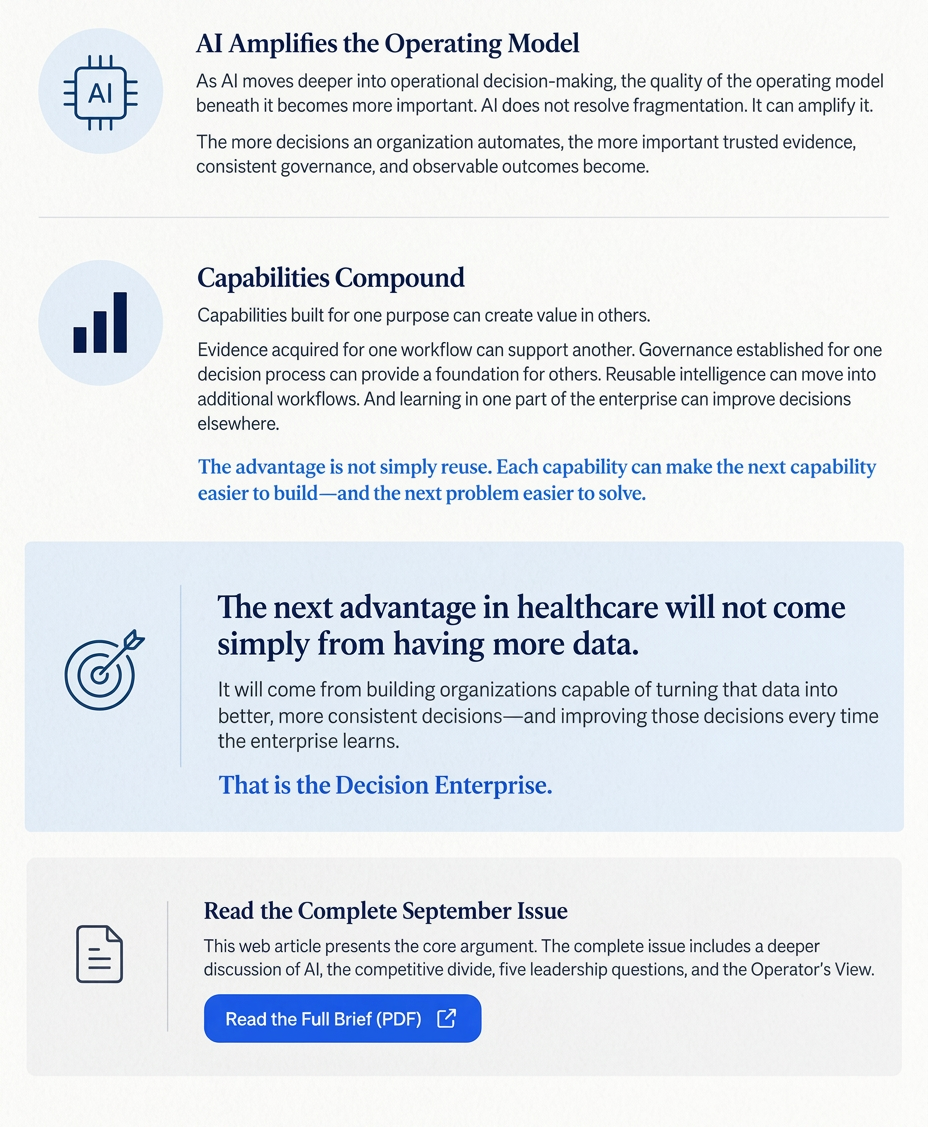
Evidence can be shared. Intelligence can be reused. Governance can become more consistent. Decision services can support multiple workflows. Outcomes can feed learning back into the enterprise.
The result is a reinforcing cycle:
Signal → Evidence → Decision → Action → Outcome → Learning
And as that cycle becomes more connected across the organization, the health plan becomes better able to translate what it knows into what it does.
That is the organizational shift: from a collection of functions that make decisions to an enterprise designed to make better decisions together.
SECTION V —
The Architecture Beneath the Decisions
The Health Plan Decision Stack
A Decision Enterprise depends on more than good intent. It requires a set of foundational capabilities that work together to turn data into trusted evidence, evidence into intelligence, and intelligence into better decisions.
I call this the Health Plan Decision Stack.
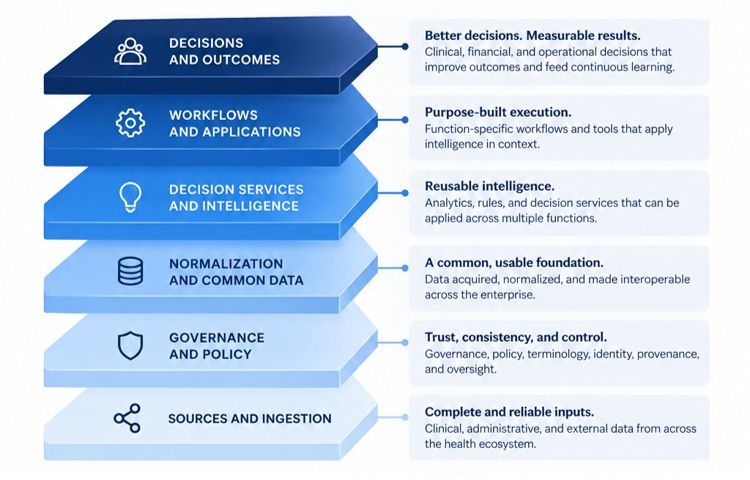
Each layer enables the one above it. Decisions at the top are only as trustworthy as the evidence, intelligence, and governance beneath them. When these layers work together, functions can make better decisions without having to reconstruct the same foundations on their own.
The Decision Stack is not a single system. It is a coordinated set of capabilities that can be built over time, using proven technologies and operational approaches.
It provides the architecture a modern health plan needs to become a Decision Enterprise.
A stronger Decision Enterprise starts with a stronger foundation.
SECTION VI —
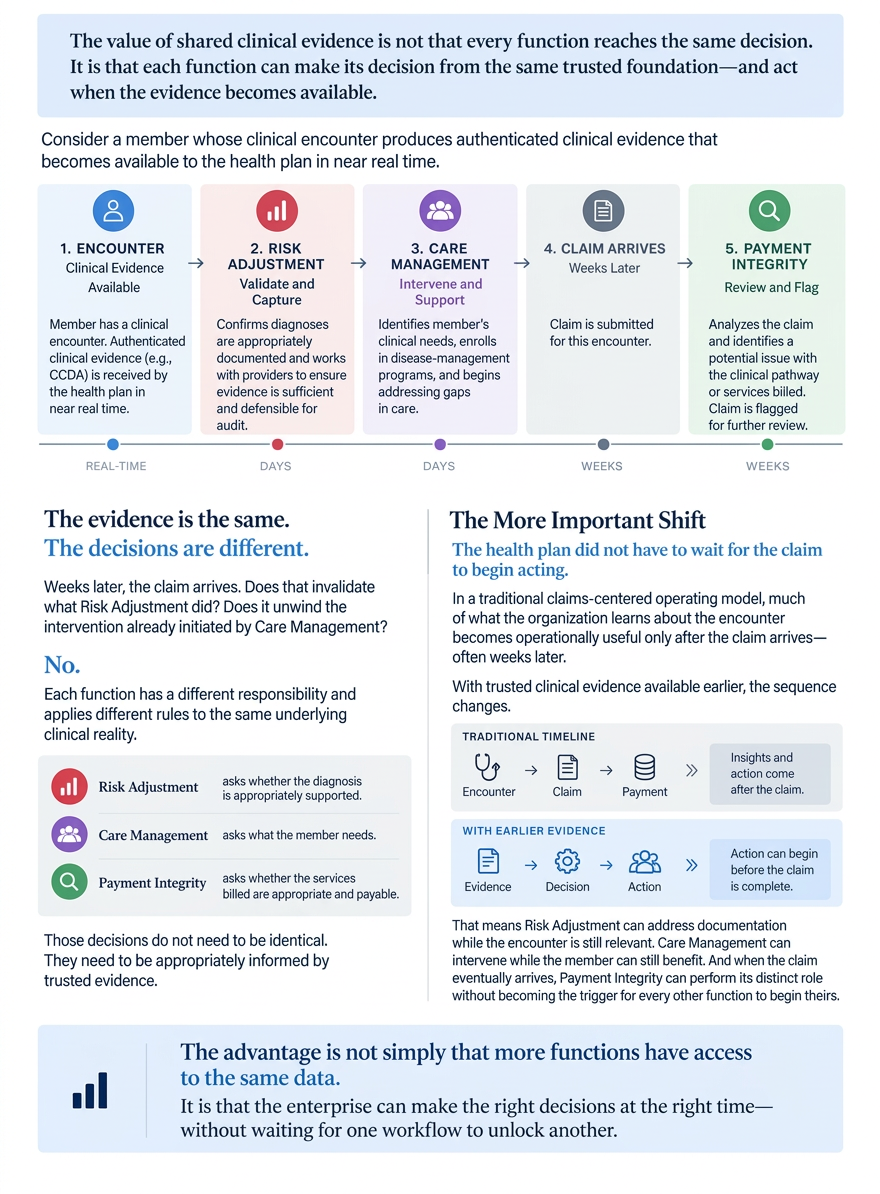
What Changes When Evidence Arrives Earlier?
One Member. One Encounter. Different Decisions.